How to Choose a Commercial Swim Spa for Your Resort
Selecting the right swim spa for a resort property involves more than picking a size from a catalog. You are investing in a guest-facing amenity that must perform reliably under heavy use, look impressive in a premium setting, and hold up in your specific environmental conditions. This guide walks through the decisions that matter most for commercial buyers.
What Size Swim Spa Does a Resort Need?
The Aqua Lux Pro product line offers two primary configurations: the square AP SWIM SPA-S (2200 x 2200 mm) and the round AP SWIM SPA-C (diameter 2200 mm). Both accommodate the same core swim experience, but the choice affects how your pool deck feels.
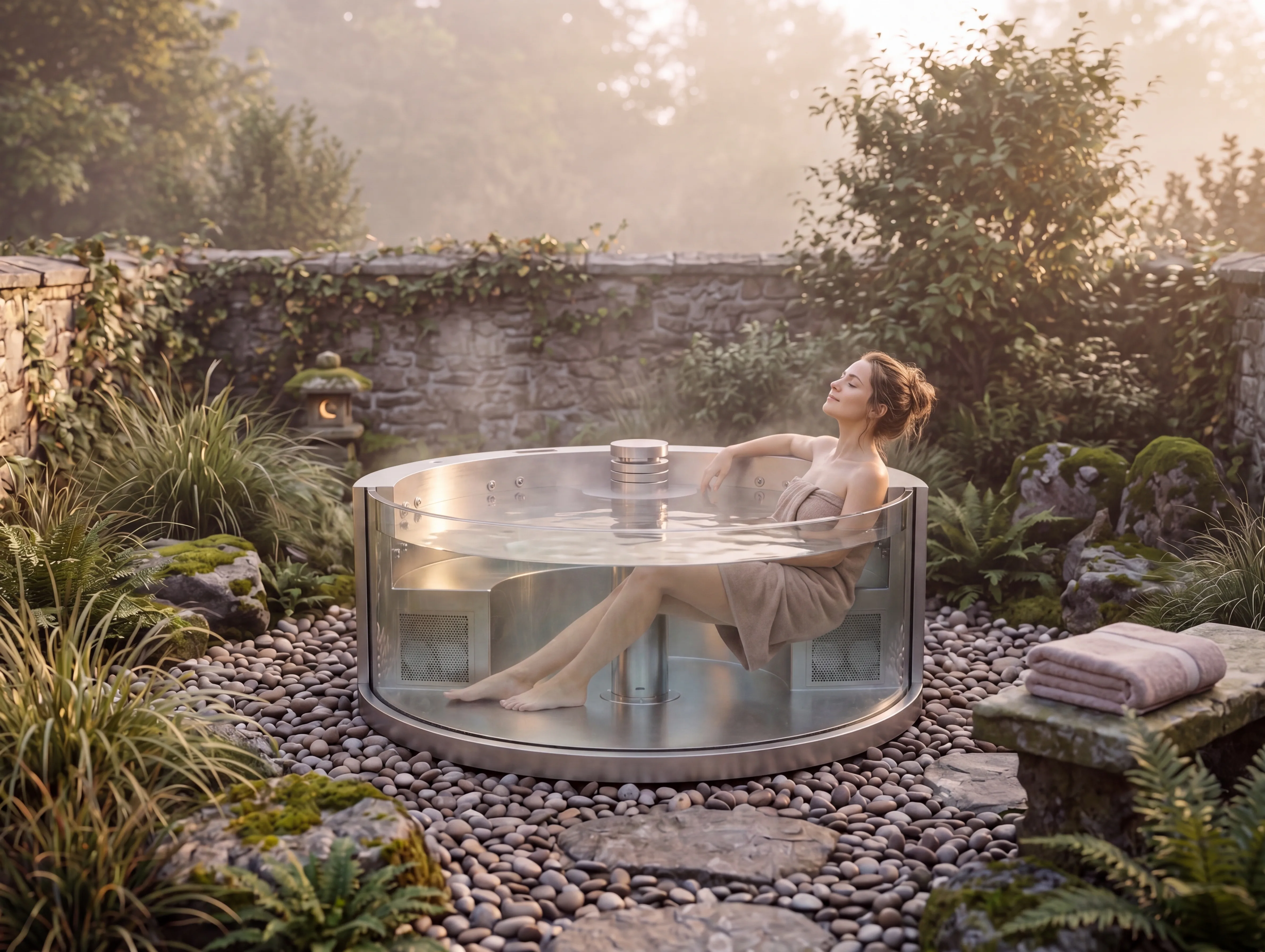
The square SPA-S model integrates cleanly into rectangular deck layouts common at modern resorts. Its transparent front panel becomes a visual feature when positioned facing guest lounging areas. The round SPA-C model works well for circular pool zones, garden settings, and standalone wellness pavilions where the spa itself is a sculptural centerpiece.
For mid-size to large resorts, multi-unit deployment is the standard approach. A resort with 80-200 rooms typically installs 2-4 units distributed across different pool zones, villa clusters, or spa buildings. This avoids queuing during peak hours and allows each unit to serve a defined guest area without excessive foot traffic between zones. For cost planning, see our commercial plunge pool cost guide for budgeting frameworks that also apply to swim spa projects.
304 vs 316: Which Material Grade for Resort Environments?
The single most consequential specification decision for a resort buyer is the stainless steel grade. We have a detailed 304 vs 316 comparison page, but the resort-specific summary is straightforward:
- 304 stainless steel is the correct choice for inland resorts, city hotels, and properties more than 5 km from the coast using freshwater. It provides full corrosion resistance for these conditions at approximately 15–20% lower cost than 316.
- 316 stainless steel is the required choice for beachfront resorts, saltwater pool systems, and any property within 5 km of the ocean. The molybdenum content (2-3%) in 316 prevents the pitting corrosion that salt spray and chloride-rich air cause in lesser grades.
If your resort has both inland and beachfront locations, standardizing on 316 across the portfolio simplifies maintenance planning and eliminates the risk of a wrong-spec unit ending up at a coastal property.
What Features Matter Most for Guest Experience?
Guests do not read spec sheets. They notice three things: how the spa looks when they walk onto the pool deck, how it feels when they get in, and whether everything works without fuss. Focus your specification on the features that create those impressions.
- Transparent front panel. Available on the SPA-S model, the tempered glass panel turns the spa into a visual feature. Guests on loungers see the illuminated water and stainless steel interior even when the spa is not in use.
- LED lighting system. Multiple color modes with remote control let resort staff set the ambiance for daytime, evening events, or branded color schemes. Lighting is one of the highest-return upgrades for the guest perception of quality.
- Massage jets and bench layout. Both models include a seated massage bench with multiple jet positions. The layout supports 4-6 adults comfortably, which aligns with typical resort guest group sizes.
- Quiet operation. The insulated cabinet and quality pump mounting reduce noise to levels that do not carry across a quiet pool deck. This matters far more at a resort than in a private home.
The ozone + UV water treatment system included in every unit also reduces the chlorine smell that guests associate with poorly maintained hotel pools. Combined with the non-porous acrylic surface that resists biofilm buildup, the system keeps water fresh with lower chemical demand.
How Many Units Should a Resort Order?
Unit count depends on guest capacity, property layout, and operational model:
- Boutique resort (under 40 rooms): 1-2 units. One as the anchor pool-deck feature; a second in the spa or villa area if the property has one.
- Mid-size resort (40-150 rooms): 4-8 units. Distribute across main pool, adult-only zone, spa building, and premium villa clusters.
- Large resort (150+ rooms): 8+ units with phased deployment. Start with 4-6 units in the highest-visibility zones, monitor guest usage patterns for 3-6 months, then expand to additional locations based on actual demand.
Phased deployment is recommended for first-time commercial spa buyers. It reduces upfront capital commitment and gives your operations team time to develop maintenance routines before scaling. Bulk orders of 4+ units may qualify for volume pricing — ask your sales contact.
What About Installation and Maintenance?
Site preparation for a commercial swim spa is more involved than for a residential hot tub, but the requirements are well-defined:
- Foundation: A level reinforced concrete pad rated for the filled weight of the unit (approximately 2,500 kg when filled). The pad should extend at least 500 mm beyond the spa footprint on all sides for service access.
- Electrical: Dedicated circuit per unit, with specifications provided in the installation manual. A qualified local electrician must handle the final connection.
- Water supply and drainage: Standard garden-hose connection for filling; gravity drain or pump-assisted drain depending on site grading.
- Staff training: We provide remote video walkthroughs and printed English manuals covering daily water testing, filter cleaning cycles, and basic troubleshooting. Most resort maintenance teams are operational within one training session. See our commercial swim spa maintenance guide for the complete daily, weekly, and monthly routine.
Routine maintenance on a commercial unit averages 15-20 minutes per day for water testing and visual inspection, plus a weekly 30-minute filter cleaning cycle. The ozone + UV system handles the bulk of sanitization automatically.
Why Source Swim Spas from China?
The swim spa market splits roughly into two tiers: European-manufactured units at EUR 25,000-50,000+ with 3-6 month lead times, and Chinese-manufactured units that deliver equivalent material quality (premium cast acrylic, marine-grade stainless steel) at significantly lower cost with shorter lead times.
Aqua Lux Pro operates in the second tier but with a deliberate focus on the materials and processes that matter for commercial applications — no mixed-material shortcuts, no plastic panels. Our 45-day production cycle and export-ready fumigated wooden crate packing (HS code 9506.99.9000) are designed for predictable B2B procurement.
The cost difference is substantial: a European-made stainless steel swim spa of comparable specification typically costs 2-3x the Aqua Lux Pro equivalent. For a resort ordering 4-8 units, that difference can fund an entire additional pool-area renovation or a year of maintenance operations.